
I am an astronomer, with the lives of compact objects --- black holes and neutron stars --- and their massive star progenitors as my main interests. I am especially interested in how the processes involved in star formation limit the possible initial configurations of binary massive stars, and how binary stars can change our predictions for star formation. I have worked mainly with population synthesis and detailed stellar evolution codes, and aim to extend my research to their interface with N-body and star formation simulations.
As of October 2025, I am a Humboldt Research Fellow at Heidelberg University's Institute for Theoretical Astrophysics, working with the DEMOBLACK group. I obtained my Ph.D. in Astronomy at the University of São Paulo's IAG in June 2025, and my B.Sc. in Physics at the University of São Paulo's IFSC in February 2021.
Documentation for BOSSA (Binary Object environment-Sensitive Sampling Algorithm) now available here.
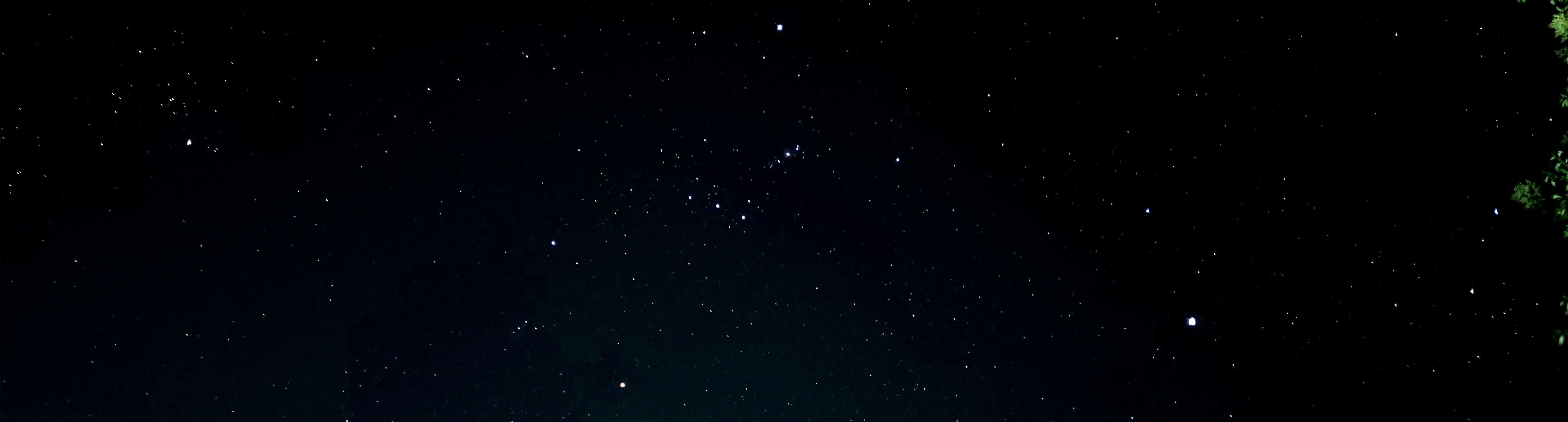
(banner is a picture of Orion taken by me from my hometown in São Paulo)
Projects
Compact object binary populations over cosmic time
Systematic variations of the stellar initial mass function (IMF) have been discussed and expected for about as long as the IMF itself has been discussed, yet its measured form has proven to be remarkably invariant over the decades. It is only relatively recently that some observations have started to offer enough support for for an environment-dependent IMF model to be produced. If the IMF does vary according to the environment, then compact object merger populations, which may have their origin in binary stars about as old as star formation itself, are particularly poised to hold clues towards such variations. Most of my research has focused on enabling us to investigate the full range of variations induced in compact object merger populations by star formation-related uncertainties, related not only to the IMF but also to orbital parameters, multiplicity and the cosmic star formation history. This resulted in the writing of BOSSA, an environment-sensitive initial sampling code for BPS, which you can find here. Find BOSSA's methods paper here, and its first use for BPS here, where we find that varying initial conditions can significantly affect merger rates and the shape of the black hole mass distribution.
The mass distribution of compact objects
Quantifying the evidence against a mass gap between black holes and neutron stars
A gap in the mass distribution of compact objects between the heaviest neutron stars (~2 M☉) and the lightest black holes (~5 M☉) after a lack of objects in this range was noted from known low-mass X-ray binaries around 2010. It has been debated since then whether this is a physical feature of the compact object population, or merely a consequence of selection effects, and the first case has given rise to core-collapse supernova models that attempt to explain an inneficiency of this mechanism to produce 2-5 M☉ remnants. More recent compact object mass estimates however --- including from novel sources such as the gravitational-wave signal of compact object mergers --- have begun to populate the gap. We measure the probability of an empty gap given these more recent estimates, and find that a desert gap is at present strongly disfavored relative to a depleted one.
An overview of compact star populations and some of its open problems
We later reviewed the literature for new additions to the catalog of Galactic black hole masses since the gap was first discussed, including nine objects not in a low-mass X-ray binary. We collected a total 35 black hole mass estimates and summarized methods adopted for these estimates. Whenever possible, we recalculated the masses from Keplerian parameters and explicitly listed assymmetrical uncertainties, often considerable. We also summarized current standing problems with regard to neutron star populations and their masses, which were treated in detail in a later work. All associated data are available here.
Outreach
I am also involved in producing material for a general audience on high-energy astrophysics and the history of physics and astronomy through my research group's Instagram profile (accessible here, in Portuguese), which so far has also produced a two-volume book tracing the evolution of physics and astronomy from Thales to modern gravitational-wave astronomy (also in Portuguese).
C.V.
Please find my CV here.
Contact
lucas(dot)desa(at)uni-heidelberg(dot)de
Institut für Theoretische Astrophysik, Universität HeidelbergAlbert-Ueberle-Straße 5 (office, room 004)
Albert-Ueberle-Straße 2 (mail)
Heidelberg 69120